
We go back a long way. Further than I thought, when I actually stopped to think about it. For a few years we occupied roughly the same stretch of the Oxford Canal. I’m trying to remember exactly when we first met. Whenever it was, he’s not particularly easy to forget.
Villains and heroes
He’s quite a full-on character. When he throws himself into something, he really throws himself into it. During lockdown, for example, he painted his entire boat. Not painted his boat in the conventional narrowboat sense. He covered it in paintings.
He was pissed off. He was pissed off with people walking too close to his boat during lockdown. He was pissed off about the canals. He was pissed off with CRT and, as far as I remember, quite a lot of other things as well. So he painted them.
The paintings spread along the boat. There were villains and there were heroes. CRT and the council got a look in. So did cyclists. There was a First World War soldier, a rainbow emerging from a tunnel and a thank-you to the NHS in three languages. They weren’t discreet. Neither, really, is he.
One day, while he was painting, a six-year-old girl passing with her dad stopped to ask what he was up to. He started to explain, then offered her a paintbrush so she could add something to the boat herself. “Well, you’ve got to encourage them”.
A daisy and a bird
Being pissed off is quite a good motivator for this particular man. If something bothers him enough, there is a reasonable chance that sooner or later he’ll do something about it. But I’ve come to realise there’s another thing that motivates him just as strongly: friendship.

Years ago, I had an idea for a daisy-shaped chimney topper for my first boat, Daisy, and commissioned him to make it. Then somebody stole it. The part of this story that warms my heart is what happened afterwards: he made me another one.
I still have it. The boat Daisy is no longer mine … but I kept the daisy and repainted it in Craftybird colours. The dome has red and blue stripes; the petals are green and yellow. Something made for one boat has just become part of another.

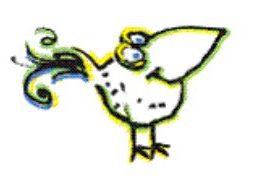
A while ago I asked him whether he thought it might be possible to make a tiny version of the Craftybird bird to sit behind the tiller arm at the stern of Craftybird. It was just an idea. We talked about it, and then I forgot about it. He didn’t. He produced it two years later and gave it to me one evening when our boats were passing.
S/he’s about 40mm high. Her head is a steel ball; her eyes are socket-headed bolts. Spring washers became spectacles, and a washer and machine screw became a hat. Her beak was welded on and ground into shape. Her wings are a bit of oven rack. There is an M12 nut welded underneath so she can be screwed onto the boat. He’d thought about how she would be attached, whether she’d work loose and, inevitably, given my previous experience with the daisy, whether somebody might nick her.
The finished bird is tiny, but extraordinary when you notice her (or him - or they?).

An inch of water
And then there is the drought and the impact it’s having on water levels in the canal system. While most of us can manage to be pissed off about the state of the canals without producing anything more useful than a rant in the pub or on Facebook, he started doing calculations. He’d been thinking about the amount of water we lose from the canal system and what might happen if, in selected places, the level were raised by just 25mm. An inch. It doesn’t sound much. Spread over a mile of canal, it suddenly becomes rather more interesting.
He calculated that, depending on the pound, that extra inch could retain around 300 cubic metres of water per mile. On the South Oxford summit his figures suggested roughly 3,300 cubic metres; at Calcutt, around 4,223. And, characteristically, he didn’t think everyone should simply take his word for it. Try it. Use something removable. Timber or steel. Raise an overflow somewhere suitable, monitor it for twelve months and find out what actually happens. If 25mm works, perhaps try 50.
His thinking went wider than that: reservoirs, pumping, the movement of water around the system, and what the canals might learn from the way water companies move water around their networks.
There were also planted sausages. I confess I need to return to my notes before attempting to explain the planted sausages.
There is one other thing you should probably know. He rather likes being a man of mystery. When I wrote about his painted boat, he didn’t want his name used. When he made the Craftybird bird, he didn’t particularly want his name attached to that either. I don’t think it’s because he doesn’t want people to see what he’s done. I think he rather enjoys leaving them wondering who did it.
So I’m not going to tell you his name now either. He’ll know who he is. And I just know he is brilliant.
ADDENDUMS
Letter to Waterways World about proposed changes to water levels

Response from Canal and River Trust


